


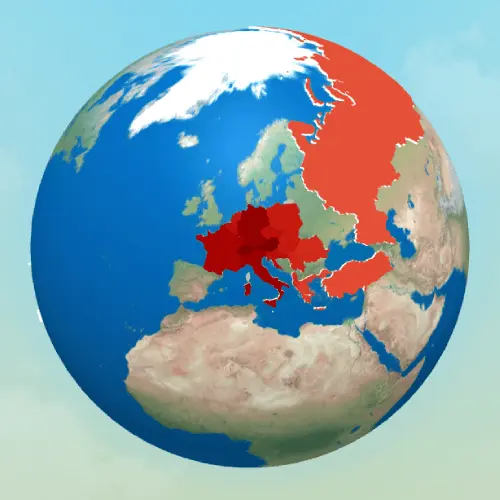
Globle
Globle is a daily geography puzzle built around one focused challenge: identify a hidden country with as few guesses as possible. Instead of searching for a word from…
 Works on Desktop & Mobile
Tested By XoomGames
- Test date
- August 20, 2026
- Tested on
- Chrome 150
- Device
- Desktop
- Operating system
- macOS and Windows
- Game loaded successfully
- Yes
- Fullscreen works
- Yes
- Sound works
- Yes
- Save progress
- Local browser storage
- Mobile compatibility
- Partially tested
- Keyboard controls
- Working
- Controller support
- Not detected
- Average loading time
- 4.2 seconds
- Known issues
- Minor delay after entering fullscreen
Globle not loading?
- Refresh the page.
- Disable restrictive content blockers temporarily.
- Confirm JavaScript and WebGL are enabled.
- Clear the browser cache.
- Try another modern browser.
- Close unnecessary tabs.
- Switch off VPN if the game server is blocked.
- Use the Report a Problem button if the issue continues.
Related Games
Continue Playing
Daily Challenge

Play 4 minutes today in Globle.
Leaderboard
- 1Community rating4.7 ★
- 2Player likes882
- 3Total votes956
- 4Your local progress0%
Your progress is saved locally in this browser. No account required.
 Your progress is saved locally in this browser. No account required.
How to Play
Start by thinking of Globle as a location search, not a one-shot trivia question. You do not need to know the answer immediately. Your first country establishes a reference point; the feedback after that guess tells you how to make a more informed second choice.
- Enter a country name. Choose any country you know. A centrally located country can be useful for a broad opening test, while a country in a specific region can test an early hunch.
- Submit the guess. Use the country entry field and press Enter to add your attempt.
- Read the geographic feedback. Look at the distance and direction associated with the guess. Ask whether the target is generally north, south, east, or west of where you started.
- Inspect the globe. Your incorrect guess appears on the map. Rotate, zoom, or pan as needed to understand the relevant area.
- Make a purposeful follow-up guess. Select a country that moves in the indicated direction or checks a plausible region. Avoid choosing a country only because its name comes to mind.
- Refine the search. Continue comparing new feedback against earlier attempts until one country best fits the remaining location clues.
For example, if an early country is far from the answer, do not make a tiny move to a neighboring country. Use the direction clue to move a meaningful distance across the map. Once later guesses are closer, switch from broad regional testing to comparing nearby countries. This shift from wide exploration to precise elimination is the game’s most useful skill.
The winning condition is straightforward: guess the mystery country. Efficiency is part of the challenge, so it is worth pausing before each entry. A deliberate guess can reveal far more than several unconnected guesses.
On mobile: use on-screen buttons or gestures when the game supports them.
 On mobile: use on-screen buttons or gestures when the game supports them.
Controls
- ↑Jump
- ← →Move Left / Right
- ↓Crouch
- W / ↑Climb / Interact
- S / ↓Drop / Slide
Globle uses a small set of controls centered on country entry and globe navigation. The map actions are useful for viewing previous guesses and orienting yourself around the target region.
| Action | Control |
|---|---|
| Enter a guess | Type a country name |
| Submit guess | Enter |
| Rotate globe | Left-click |
| Zoom map | Mouse wheel or middle-click |
| Pan map | Right-click |
| Begin play | Tap the globe |
Use rotation when the countries you need are on the far side of the globe. Zooming can help when your search has narrowed to a compact region, while panning gives you a way to reposition the visible map. These map controls do not solve the puzzle by themselves, but they make the distance-and-direction clues easier to place in context.
Game Progress & Challenges
Why Play This Game?
 Instant PlayPlay instantly in your browser.
 Free to PlayNo hidden fees.
About "Globle"
Globle is a daily geography puzzle built around one focused challenge: identify a hidden country with as few guesses as possible. Instead of searching for a word from letter clues, you enter country names and use the results to work out where the mystery location is on the world map.
Every incorrect country becomes useful information. Your guess appears on the globe, while distance and direction feedback helps narrow the search area. A country that seems geographically close is a stronger lead than one far away, so each attempt should change your next decision. The puzzle rewards broad map knowledge, but it also rewards logical elimination. You can make progress by comparing regions, neighboring countries, islands, continents, and likely directions.
The central appeal is its short, repeatable daily format. There is one mystery country to solve, making Globle a useful choice for players who enjoy geography trivia without needing a long session. It can be approached casually with a few exploratory guesses or more methodically by tracking which parts of the map have become more promising.
For players looking for thoughtful browser games, Globle turns a world map into a deduction puzzle. The answer matters, but the real game is learning how each country guess changes the geographic picture.
Gameplay
Globle gameplay begins when you enter the name of a country as your first guess. That country is not simply marked right or wrong unless it is the answer. Instead, the game provides location-based feedback that points you toward the daily mystery country. The goal is to interpret that feedback and reach the correct country in the fewest possible guesses.
Distance is the key measurement. A guess that is geographically nearer to the target is more valuable than a distant guess because it reduces the remaining search space. Direction adds another layer: it tells you which way the answer lies relative to your current guess. Together, these clues create a map-reading problem rather than a pure test of memorized capitals or flags.
A productive round often develops in stages:
- Make an opening country guess to establish a starting point on the globe.
- Use the distance and direction result to decide which broad region deserves attention.
- Choose another country that tests that region rather than repeating a similar location without a reason.
- Compare the new feedback with earlier guesses and keep closing in on the target.
- Enter the suspected mystery country to complete the daily puzzle.
Because incorrect guesses remain visible on the globe, the board becomes a record of your investigation. That visual history is important: it prevents the puzzle from feeling like random country-name entry and lets you see how your search has moved across the world. A strong player treats every guess as a geographic question, such as whether the answer is farther east, nearer an ocean, or located in a different continental zone.
The daily structure also encourages a clean reset in thinking. Rather than relying on a permanent campaign or collection system, the challenge is to solve the current country efficiently and return for the next mystery.
Platform
Globle is presented as a web-based country guessing game with an interactive globe, text entry, and mouse-driven map navigation. The puzzle is suited to a browser session because its main actions are simple: type a country name, submit it, and inspect the map feedback.
On a computer, the globe can be rotated, zoomed, and panned with mouse inputs. These actions are helpful when you need to inspect a region, distinguish nearby countries, or follow the position of previous guesses. The game also supports tapping the globe to begin, which reflects its map-focused interface.
The game’s core experience does not depend on fast reactions, a controller, or complex key combinations. Its main requirement is readable country input and the ability to study the globe carefully. That makes it more about deduction and geographic orientation than arcade speed.
A mobile app listing for a country-guessing game named Globle is also available in the research, while this page focuses on the browser-style map puzzle experience. Availability can differ by device, browser, and network settings, so the most reliable approach is to use the version available to you and confirm that the map and country-entry field load correctly.
How to Play "Globle"
Start by thinking of Globle as a location search, not a one-shot trivia question. You do not need to know the answer immediately. Your first country establishes a reference point; the feedback after that guess tells you how to make a more informed second choice.
- Enter a country name. Choose any country you know. A centrally located country can be useful for a broad opening test, while a country in a specific region can test an early hunch.
- Submit the guess. Use the country entry field and press Enter to add your attempt.
- Read the geographic feedback. Look at the distance and direction associated with the guess. Ask whether the target is generally north, south, east, or west of where you started.
- Inspect the globe. Your incorrect guess appears on the map. Rotate, zoom, or pan as needed to understand the relevant area.
- Make a purposeful follow-up guess. Select a country that moves in the indicated direction or checks a plausible region. Avoid choosing a country only because its name comes to mind.
- Refine the search. Continue comparing new feedback against earlier attempts until one country best fits the remaining location clues.
For example, if an early country is far from the answer, do not make a tiny move to a neighboring country. Use the direction clue to move a meaningful distance across the map. Once later guesses are closer, switch from broad regional testing to comparing nearby countries. This shift from wide exploration to precise elimination is the game’s most useful skill.
The winning condition is straightforward: guess the mystery country. Efficiency is part of the challenge, so it is worth pausing before each entry. A deliberate guess can reveal far more than several unconnected guesses.
Controls
Globle uses a small set of controls centered on country entry and globe navigation. The map actions are useful for viewing previous guesses and orienting yourself around the target region.
| Action | Control |
|---|---|
| Enter a guess | Type a country name |
| Submit guess | Enter |
| Rotate globe | Left-click |
| Zoom map | Mouse wheel or middle-click |
| Pan map | Right-click |
| Begin play | Tap the globe |
Use rotation when the countries you need are on the far side of the globe. Zooming can help when your search has narrowed to a compact region, while panning gives you a way to reposition the visible map. These map controls do not solve the puzzle by themselves, but they make the distance-and-direction clues easier to place in context.
Can "Globle" Unblocked?
Globle is a browser-oriented geography game, so access depends on whether the game page is available through your current internet connection and browser. If a school, workplace, library, or shared network restricts gaming websites, those local rules can prevent access even when the game itself normally runs online.
The practical way to play is to open the game through an approved connection and use the available browser experience. Do not rely on bypass tools, proxies, or methods that conflict with network policies. If the page does not load, check ordinary issues first: confirm your connection, refresh the page, make sure your browser is current, and verify that scripts or browser settings are not blocking the interactive map.
Globle does not require a complicated setup for its basic puzzle loop. Once the country-entry field and globe are working, you can begin making guesses and using the geographic feedback. Because the game is based on a daily mystery country, returning later may present a new puzzle rather than an ongoing level sequence.
For a reliable session, use a permitted device and connection, then focus on the useful part of the challenge: mapping each wrong country into a better next guess.
Tips for "Globle"
The best Globle strategy is to make every guess answer a geographic question. Random country lists may eventually find the target, but deliberate moves use fewer guesses and make the feedback easier to interpret.
- Start broad, then narrow. An early guess should establish a useful reference point. After you receive direction and distance feedback, move toward the indicated part of the world rather than making another unrelated selection.
- Use direction before precision. When the answer is still far away, the important clue is often the broad direction. First identify the likely continent or large region; only then worry about neighboring countries.
- Respect distance changes. Compare each new result with the previous one. If a new country is closer, you are moving productively. If it is farther away, reconsider the direction or region you chose.
- Turn the globe into notes. Since incorrect guesses appear on the map, use their positions as visual evidence. Several guesses from different sides of a region can help you mentally bracket the target.
- Choose test countries with intent. If you are unsure whether the answer is in northern or southern parts of a large area, select a country that clearly separates those possibilities. A useful test produces a meaningful change in feedback.
- Watch for geographic exceptions. Island countries, widely separated territories, narrow borders, and countries near continental edges can make intuition less reliable. Zoom and rotate the globe instead of relying only on a flat-map memory.
- Do not confuse familiarity with probability. A well-known country is not automatically the best next guess. Let the current clues determine your choice.
A particularly effective habit is to alternate between two modes. In exploration mode, make larger moves that identify the correct side of the world. In confirmation mode, make smaller moves among plausible nearby countries. Knowing when to switch prevents wasted attempts. If the target still seems distant, test a broad region; if you are consistently getting closer, use the map to compare local possibilities more carefully.
Finally, take a moment after every submission. The puzzle is designed around geographic feedback, so the value of a guess comes from what you learn before typing the next country.
Features "Globle"
Globle combines a familiar daily-puzzle format with a world geography focus. Its strongest feature is that it transforms wrong answers into usable clues instead of treating them as simple failures. Each incorrect country is placed on the globe, creating a visible trail of the player’s search.
- Daily mystery country: The puzzle centers on finding one hidden country, with a new mystery country described as appearing daily at midnight UTC.
- Country-name guessing: Players enter country names directly, keeping the task focused on geography rather than multiple-choice selection.
- Distance feedback: Guesses provide a measure of how far they are from the target, helping players judge whether a move improved their position.
- Direction clues: Direction information helps convert a distant guess into a plan for the next region to investigate.
- Interactive globe: The world map can be rotated, zoomed, and panned, which supports visual geographic reasoning.
- Visible guess history: Incorrect guesses remain on the globe, allowing players to review the route their deduction has taken.
- Low-pressure puzzle pacing: The challenge is based on analysis and map knowledge rather than timers, reflexes, or elaborate command inputs.
The important design advantage is the combination of feedback types. Distance alone might tell you that a guess was poor, but direction gives that distance a practical meaning. The globe then gives both clues spatial context. This three-part loop—enter a country, read the location feedback, inspect the map—makes the puzzle accessible to players who know world geography well and to players who want to improve it through repeated play.
Globle also works as a compact learning exercise. It encourages you to recall where countries are located, recognize regional patterns, and notice how countries relate to one another across the world. The game does not need a long tutorial because the core objective remains clear throughout: use each attempt to locate the mystery country more efficiently.
Best "Globle" Similar Games & Top Picks
- Cut the Rope: Play Cut the Rope unblocked on XoomGames. Cut ropes, collect stars, and guide candy to Om Nom in your browser.
- Enclose Horse: Play Enclose Horse unblocked on XoomGames. Place fences, guide the horse, and build a valuable meadow in your browser.
- Word Wipe: Play Word Wipe unblocked on XoomGames. Connect adjacent letters, clear rows, and build words against the clock in your browser.
- Match Arena: Play Match Arena unblocked on XoomGames. Swap colorful tiles, chase goals, and challenge real players in browser match-three battles.
- Plactions: Play Plactions unblocked on XoomGames. Plan jumps, dashes, gravity flips, portals, and laser toggles to reach each exit in your browser.
FAQ - Globle
What is Globle?
Globle is a geography guessing game in which you try to identify a hidden mystery country. You enter country names as guesses, then use map-based distance and direction feedback to work toward the correct answer. The objective is to solve the puzzle in as few guesses as possible.
How do you win Globle?
You win by entering the mystery country correctly. Incorrect country guesses are still useful because they appear on the globe and provide geographic feedback. Compare the direction and distance from your guesses to the target, then choose a country that better fits those clues.
Does Globle have a new puzzle every day?
Yes. The game is described as a daily country guessing game with one new mystery country each day at midnight UTC. That format gives players a fresh geography challenge while keeping the main goal consistent from round to round.
What do distance and direction mean in Globle?
Distance tells you how far your guessed country is from the mystery country. Direction tells you where the target lies relative to that guess. Use both pieces together: a country that is closer and positioned in the indicated direction is usually a stronger next step than a random country elsewhere on the map.
Are incorrect guesses shown on the map?
Yes. Incorrect guesses appear on the globe. This creates a visual history of your attempts and helps you see which regions you have already tested. Reviewing those markers can help you avoid repeating the same weak line of reasoning and makes it easier to narrow the search area.
How do I enter a country guess?
Type the name of a country into the game’s entry field and press Enter to submit it. The game then uses that country as your current guess and provides the geographic feedback needed for your next decision.
What are the Globle map controls?
On the web version, left-click rotates the globe, the mouse wheel or middle-click zooms, and right-click pans the map. You can also tap the globe to start playing. These controls help you inspect regions and place your guesses in geographic context.
Is Globle mainly a trivia game or a strategy game?
It is both, but its strategy comes from deduction. Knowing where countries are located is useful, yet you do not need to know the answer immediately. Strong play means reading the distance and direction feedback, testing regions deliberately, and moving from broad world-map guesses to precise local comparisons.
More Games Like This
 Cut the Rope
Puzzle ★ 4.7
 Enclose Horse
Puzzle ★ 4.7
 Word Wipe
Puzzle ★ 4.7
 Escape Room: Mystery Key
Puzzle ★ 4.7
 Match Arena
Puzzle ★ 4.5
 Plactions
Puzzle ★ 4.6
 The Coffin of Andy and Leyley
Puzzle ★ 4.7
 The Idiot Test
Puzzle ★ 4.5
 Escape Raid
Puzzle ★ 4.6
 Pink
Puzzle ★ 4.7
 Blumgi Bloom
Puzzle ★ 4.7
 Thief Puzzle
Puzzle ★ 4.6
 The Man from the Window 2
Puzzle ★ 4.4
 You vs Homer
Puzzle ★ 4.6
 Report a Problem
Comments About Globle